How aluminium blister foil protects pharmaceutical products
WHO guidance, FDA rules, and published stability research on the aluminium barrier that protects tablets and capsules, the standard Nisan's pharmaceutical foil is built to meet.
What pharmaceutical packaging has to do
WHO guidance on pharmaceutical packaging states that packaging preserves the stability and quality of medicinal products and protects them against all forms of spoilage and tampering, and that medicines must be protected in particular against moisture, light and oxygen throughout their shelf life.¹ The same guidance defines a blister as a container of two layers, one of which is shaped to hold the individual doses.¹
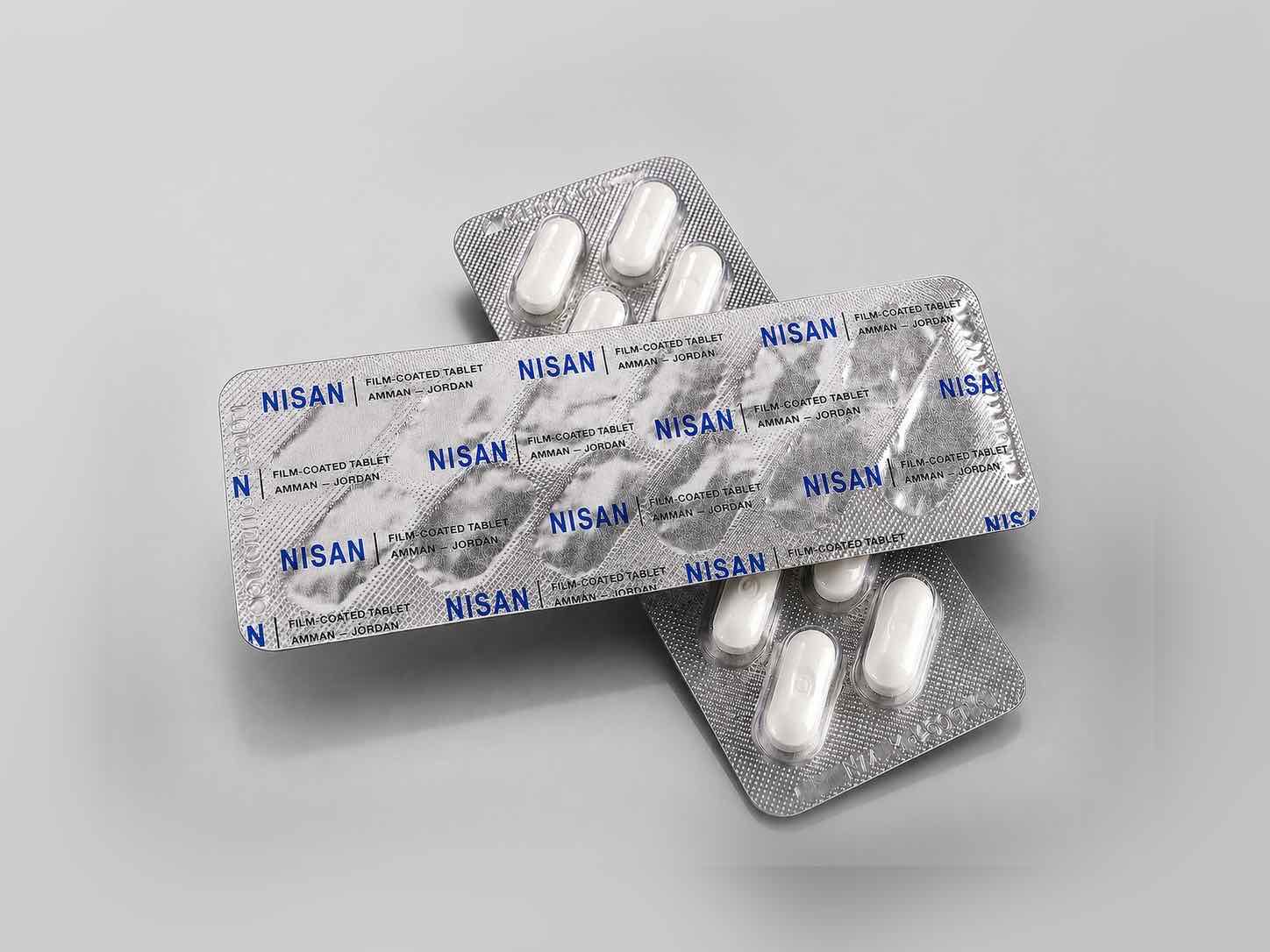
Nisan's pharmaceutical-grade aluminium blister foil is designed to protect tablets, capsules, and other pharmaceutical products against moisture, oxygen, and light, supporting product stability, safety, and shelf life.
Aluminium is the strongest moisture barrier
Published stability research quantifies the difference. In an International Journal of Pharmaceutics study, the moisture permeation of blister materials ranged from 0.259 mg per blister per day for PVC down to 0.001 for cold-form aluminium (a construction with an all-aluminium forming film and lidding); after six months at 40 °C and 75% relative humidity, a moisture-sensitive tablet retained 84% of its active ingredient in PVC blisters but 100% in cold-form aluminium, and 99% in a bottle closed with a foil induction seal.² The authors state that the most impermeable moisture barrier is provided by cold-form aluminium foil.²
A review of pharmaceutical blisters notes that regardless of which forming film is used, the lidding material is usually aluminium because it can isolate drugs from the air and is mechanically stable.⁴
Nisan's blister foil is the aluminium lidding layer, produced in 20, 25, and 30 micron across multiple temper grades, and is sealed onto a PVC, PVDC, PP, or PE forming film rather than an all-aluminium cold-form base. The barrier figures above describe fully cold-formed constructions specifically; the overall moisture protection of a thermoformed blister also depends on the forming film selected alongside the foil.
Sealing to the blister base
A blister only protects if the foil seals reliably to the base web. A blister package combines a forming film, a heat-seal coating, the aluminium lidding, and printing,⁴ and WHO guidance describes hermetically closed containers as those impervious to air or other gases under normal handling.¹
Nisan's blister foil is sealable to the common blister bottom substrates (PVC, PVDC, PP, and PE) and is produced for automated pharmaceutical packaging lines.
Tamper evidence
Tamper evidence is a regulatory expectation. The FDA's tamper-resistant packaging guidance treats blister or strip packs as a recognised tamper-evident technology: dosage units are sealed between plastic compartments and foil or paper backing that cannot be separated or replaced without leaving visible evidence of entry. The guidance also notes that container-mouth seals applied by heat induction offer a higher degree of tamper resistance than seals that rely on adhesive.³
Nisan supplies both pharmaceutical blister foil and two-piece induction liners that bond to the container rim through a non-contact induction sealing process.
Identification: batch and expiry coding
WHO guidance requires the label of a finished drug product to carry, among other details, the manufacturer's batch number and the expiry date in uncoded form.¹
Printing runs in-house on Nisan's flexographic lines using food-grade inks, with high-definition clarity and precise batch and expiry date coding where applications require it, under an ISO 9001 certified quality system, with raw aluminium sourced from a GMP-certified European manufacturer.
A note on end of life
Aluminium's barrier strength comes from a multi-layer structure, which carries an end-of-life cost: a review of pharmaceutical blisters notes that because they combine plastic and aluminium in thin layers, they are hard to recycle and need a separation step before the materials can be recovered.⁴ This is an industry-wide characteristic of high-barrier blisters, noted here for completeness rather than as a Nisan-specific claim.
References
- 1.World Health Organization, Guidelines on packaging for pharmaceutical products. WHO Technical Report Series No. 902, Annex 9 (2002).
- 2.Allinson, Dansereau & Sakr, The effects of packaging on the stability of a moisture sensitive compound. International Journal of Pharmaceutics, 2001.
- 3.U.S. Food & Drug Administration, CPG Sec. 450.500, Tamper-Resistant Packaging Requirements for Certain Over-the-Counter Human Drug Products.
- 4.Çapkın & Gökelma, A review on characterization and recyclability of pharmaceutical blisters. Cleaner Waste Systems, 2023.
Related products
Related industries
Enquiries