How paper-foil-plastic laminate lids protect packaged food
A documented paper-foil-plastic lid structure, food-contact safety testing, and packaging research, set against how Nisan's paper-foil laminate is built.
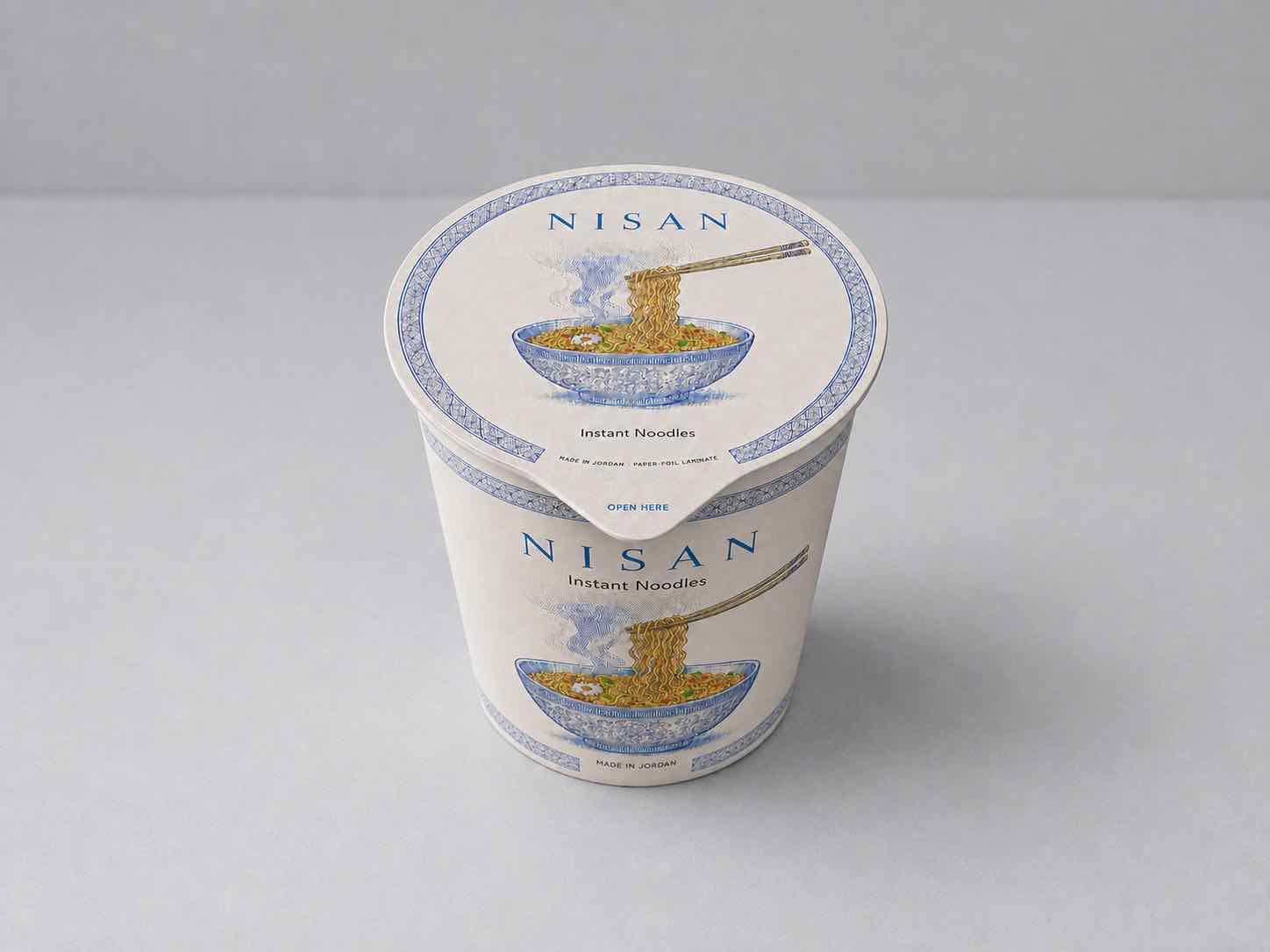
Why some lids combine paper, foil, and plastic
Each material in this laminate does a different job. In multi-layer packaging materials consisting of polyethylene, paperboard, and aluminium, research on disposable food packaging notes that the polyethylene is applied for its easy sealing and barrier properties to water, the aluminium layer provides a barrier to oxygen, and the paperboard ensures the required rigidity of the packaging.¹ A review of multilayer flexible food packaging similarly identifies aluminium foil as protecting contents from moisture, oxygen, and light.²
Put together, the three materials cover what none of them can do alone: paper for stiffness, printability, and machine handling; plastic for moisture resistance and heat-sealing; aluminium foil for the oxygen and light barrier.
A documented structure: the instant-noodle cup lid
One specific, publicly documented example of this laminate is the instant-noodle cup lid. A Chinese utility patent for such a lid describes a six-layer structure: a printed layer, a paper layer, a first polyethylene (PE) bonding layer, an aluminium foil layer, a second PE layer, and an EVA (ethylene-vinyl acetate) heat-seal layer.³ The patent specifies that the underside of the aluminium foil carries an embossed texture, which reduces the contact area between the lid and the bowl rim, making the lid easier to peel, and keeps stacked lids from sticking together during high-speed vacuum-suction feeding on packing lines.³
| Layer | Main purpose |
|---|---|
| Printed layer | Branding and preparation instructions |
| Paper | Stiffness, printability, and machine handling |
| PE bonding layer | Laminates the paper to the foil |
| Aluminium foil (embossed) | Barrier against oxygen, moisture, and light; embossing eases peel and machine feeding |
| PE layer | Moisture resistance and lamination |
| EVA heat-seal layer | Low-temperature sealing and clean, easy peel from the rim |
Why fried instant noodles need this barrier
The barrier matters because of what is inside. Fried instant noodles typically contain 15–20% oil and fat and are generally required to hold a shelf life of 2 to 12 months; research on frying oil quality states that this shelf life largely depends on the oxidative stability of the frying oil.⁴ A lid that limits oxygen and moisture ingress protects both the oil in the noodles and the dried seasonings and vegetables in the cup, the combination a paper-foil-plastic laminate is built to provide.
Matching the lid to the cup material
The lid's heat-seal layer has to bond to whatever the cup is made from, and cups are not uniform. A Hong Kong food-safety study of the market identified cup materials as polyethylene-coated paper, expanded polystyrene, and polypropylene, with lids correspondingly made as composite laminated films with polyethylene, polystyrene, or co-polymer contact surfaces, or as polypropylene or polystyrene alone.⁵ A sealant formulated for one cup substrate is not automatically assumed to work on another, the contact layer is selected for the specific cup material it has to seal to.
Food-contact safety under real preparation conditions
Standard preparation exposes the lid mainly to steam at or below 100°C for about three minutes.⁵ Hong Kong's Centre for Food Safety tested cup and lid materials under more severe conditions, 100°C for 30 minutes, specifically because that stress-tests beyond normal use.⁵
Of 30 sample sets tested, 23 lids were paper, aluminium, and plastic laminates.⁵ Diaminotoluene (a residual contaminant that can remain from the polyurethane adhesives sometimes used to bond these layers) was not detected in any of the composite laminated lids tested, and total migration levels in all samples were well below the limit set by the US Food and Drug Administration.⁵
These results describe the specific market samples tested in that 2008–2009 study; they do not establish that every paper-aluminium-plastic laminate is food-safe by default. Each finished laminate structure, including any supplied by Nisan for a given application, would still need its own food-contact migration testing before use.
The recycling trade-off
The same layered construction that gives this laminate its barrier is what makes it difficult to recycle: the materials are bonded together, not simply mixed, so they generally need to be separated before either can be recovered. A review of multilayer flexible food packaging identifies delamination, separating the layers of a multi-material laminate as a pre-treatment step, as a promising but still-developing technology, alongside other approaches such as recovering aluminium from multilayer packaging by microwave-induced pyrolysis.² This is an industry-wide characteristic of paper-foil-plastic laminates generally, not a claim specific to any one manufacturer's structure.
Where Nisan's laminate fits
Nisan's paper-foil laminate follows the same three-material logic described above: a paper outer bonded to a plastic layer and an aluminium foil barrier, giving the sealing reliability and barrier protection of foil with the look and feel of paper on the surface. It is produced to each application rather than a single fixed structure, and serves dairy, ice cream and frozen desserts, instant and ready-to-eat foods, and beverage cups among Nisan's documented application areas.
The exact layer order, gauge, and sealant type for a given Nisan laminate depend on the cup material and packing line it has to run on (the same application-specific factors this article describes) and are confirmed per order rather than published as a single specification here.
References
- 1.Dybka-Stępień, Antolak, Kmiotek, Piechota & Koziróg, Disposable Food Packaging and Serving Materials: Trends and Biodegradability. Polymers, 2021.
- 2.Bauer, Tacker, Uysal-Unalan, Cruz, Varzakas & Krauter, Recyclability and Redesign Challenges in Multilayer Flexible Food Packaging: A Review. Foods, 2021.
- 3.CN202115904U, Instant Noodle Bowl Lid (utility patent), Jiangyin Yuhao Composite Materials Technology Co., Ltd., 2012.
- 4.Li, Yuan, Teng, Li, Zhou & Bi, Effects of tea polyphenols and tertiary butylhydroquinone on quality of palm oils and losses of endogenous vitamin E during batch frying and oxidative stability of fried instant noodles. Food Chemistry: X, 2023.
- 5.Centre for Food Safety, Food and Environmental Hygiene Department, Hong Kong SAR, Risk Assessment Studies Report No. 36: The Food Safety of Instant Cup Noodle Containers. 2009.
Related products
Enquiries